

As the world settles into the midpoint of the decade, 2026 stands out as more than just another calendar year. It is a crucial moment of evaluation—a year in which policies are tested against reality, political narratives are reshaped, and the performance of leaders, institutions, and systems is closely measured. After years of ambitious promises, disruptions, and recovery efforts, 2026 functions as a checkpoint between vision and results.
Testing Policies in the Real World
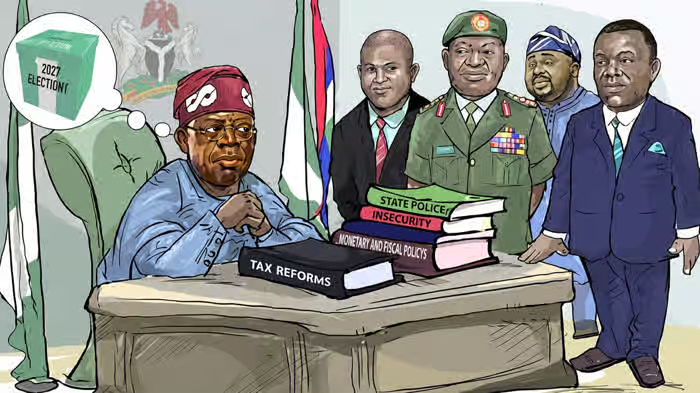
By 2026, many policies introduced earlier in the decade are no longer new experiments; they are active frameworks influencing daily life. Economic reforms, climate strategies, education changes, and technology regulations are now facing their most important test: real-world impact.
Governments are under pressure to show that their policies work not just in theory, but in practice. Inflation control measures must translate into affordable living. Environmental commitments must show measurable progress rather than symbolic targets. Digital and AI regulations must balance innovation with safety and fairness. In 2026, data, outcomes, and public experience matter more than intentions.
Shaping the Political Landscape
Politically, 2026 is a shaping year rather than a final one. In many countries, it sits between major election cycles, making it a strategic period for repositioning. Parties refine their messages, leaders adjust their priorities, and opposition groups test alternative visions.
Public trust plays a central role. Citizens are increasingly informed and vocal, using digital platforms to scrutinize decisions and demand accountability. Social issues, economic inequality, climate resilience, and governance transparency continue to influence political alignment. The narratives that gain strength in 2026 are likely to define elections and leadership choices later in the decade.
Measuring Leadership and Institutional Performance
Performance measurement is not limited to governments alone. Corporations, international organizations, and public institutions are also being judged on results. Are companies delivering sustainable growth? Are institutions adapting to rapid technological and social change? Are public services more efficient, inclusive, and resilient?
Key performance indicators now extend beyond profit and productivity. Ethical leadership, social responsibility, environmental impact, and long-term stability are part of the evaluation. In 2026, credibility is earned through consistency and delivery, not announcements.
A Bridge Between Ambition and Accountability
What makes 2026 especially important is its position in time. It is close enough to the promises of the early 2020s to demand accountability, and far enough from the end of the decade to allow for course correction. Successes can be scaled, failures acknowledged, and strategies refined.
In this sense, 2026 is a bridge year—connecting ambition with accountability. The decisions made, the lessons learned, and the performances measured during this period will influence not only political outcomes, but also public confidence in leadership and institutions.
Conclusion
2026 is not defined by grand beginnings or final outcomes, but by evaluation. It is a year to test whether policies deliver, to shape political direction through action rather than rhetoric, and to measure performance with honesty and evidence. How well societies respond to this moment will determine whether the rest of the decade is marked by progress—or by missed opportunity.


 By
By