
A Nigerian academic and activist based in the United States, Baba Adam, has called on Bola Ahmed Tinubu’s government to act decisively in defending the country’s sovereignty and dignity after a dramatic escalation in diplomatic tensions between Nigeria and the United States. The intervention comes in the wake of U.S. President Donald Trump’s public threat to deploy military force against Nigeria over allegations of widespread persecution of Christians.
The trigger: the US threat
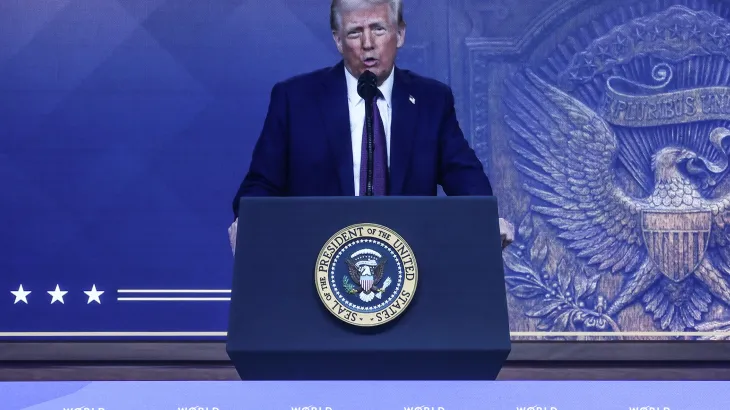
On 1 November 2025, President Trump posted on his social media platform that he had ordered the U.S. defence apparatus to prepare for possible military action in Nigeria if the Nigerian government failed to stem purported killing of “very large numbers” of Christians.
This followed the designation of Nigeria as a “Country of Particular Concern” (CPC) by the U.S., citing alleged violations of religious freedom.
In response, Nigerian officials emphasised that any U.S. intervention would need to respect Nigeria’s territorial integrity and sovereignty.
The letter from Baba Adam
In a formal letter addressed to President Tinubu and senior government officials, Baba Adam described Trump’s remarks as “reckless and unprecedented” — a form of gun‑boat diplomacy and a violation of international law.
He pressed for a series of immediate diplomatic and symbolic actions by the Nigerian government:
- Summon the U.S. Ambassador to Nigeria and lodge a formal diplomatic protest.
- File a resolution at the United Nations Security Council (UNSC) affirming Nigeria’s sovereign rights and condemning threats of aggression.
- Convene an emergency summit of the Economic Community of West African States (ECOWAS) and the African Union (AU) to declare that “an attack on Nigeria is tantamount to an attack on Africa.”
- Urge the Nigerian National Assembly to pass a resolution reaffirming Nigeria’s territorial integrity.
- Engage European allies to test their loyalty and support for Nigeria.
Baba Adam also contextualised the threat as part of a broader campaign against Nigeria — rooted, he argues, in discomfort from global actors over Nigeria’s independent foreign policy stance, its engagement with BRICS, and its economic reforms.
Nigeria’s response so far
The Nigerian presidency, through its spokesperson Daniel Bwala, stated that Nigeria welcomes U.S. assistance in the fight against terrorism provided it respects Nigeria’s sovereignty. He also noted that President Tinubu had been proactive in his reorganisation of the country’s security apparatus prior to the U.S.’s latest moves.
Nonetheless, Nigeria has firmly rejected the framing that the violence in the country is strictly about Christian persecution, pointing out that both Christians and Muslims are victims of insurgency, banditry, and communal violence.
Why this matters
The episode is significant for several reasons:
- It touches on Nigeria’s sovereignty: a large foreign power publicly threatening military action against a sovereign African state raises questions about equality in international relations, interventionism, and African agency.
- It underscores Nigeria’s internal security crisis: While the U.S. emphasis is on religious persecution, analysts in Nigeria emphasise the complex nature of violence — including insurgency, herder‑farmer conflict, and banditry — which does not conform neatly to a Christian‑vs‑Muslim framing.
- It could affect Nigeria’s foreign policy and how it engages with multiple global blocs (U.S., China, BRICS, EU). The threat may push Nigeria to more aggressively assert its independence or seek stronger multilateral protection via African institutions.
- It has implications for national unity: As Baba Adam and other commentators note, this is a moment for Nigerians across ethnicity and faith to rally around national sovereignty rather than allow external narratives to sow division.
What now for President Tinubu’s government?
According to both the activist’s letter and expert commentary, the government has several possible pathways:
- Diplomatic engagement: Holding direct talks with the U.S., clarifying the facts on the ground, requesting intelligence sharing rather than coercion.
- Pan‑African solidarity: Engaging ECOWAS, the AU and other African states to issue a collective statement/adoption of a common position that protects Nigeria from unilateral threats.
- Domestic security and narrative: Strengthening internal security operations to show progress; clarifying the nature of violence in Nigeria to the world (i.e., it is not purely religious persecution but multi‑dimensional).
- Leveraging international law/institutions: The letter recommends Nigeria join or support cases such as at the International Court of Justice (ICJ) to signal that Nigeria is not intimidated by threats.
Concluding thoughts
Baba Adam’s intervention is a reminder that citizens — including those in the diaspora — see Nigeria’s sovereignty, dignity, and reputation as stakes worth defending. In a geopolitically contested era, Nigeria’s handling of this moment under President Tinubu will send strong signals: about how the country values its independence, how it addresses internal security, and how it positions itself among global powers.
Whether the U.S. military threat is rhetorical brink‑manship or more, the fact that it prompted such a strong domestic and international response shows the sensitivity of external involvement in African security affairs.
For now, Nigeria stands at a crossroads: to respond with measured diplomacy, strengthen national capacity, and assert its voice — or risk being pulled into an external agenda under distressing framing.

 By
By